CBAM certificates represent a new type of charge borne by importers of CBAM goods. A CBAM certificate is an electronic certificate corresponding to 1 tonne of CO₂ emissions embedded in CBAM goods. It is essential for importers to correctly estimate how many CBAM certificates they will need. The final CBAM liability is the product of the number of CBAM certificates and the price of a CBAM certificate.
How do we calculate the required number of CBAM certificates?
The number of CBAM certificates is calculated by multiplying two figures. These are the specific embedded emissions per tonne of CBAM goods and the total quantity (in tonnes) of imported CBAM goods. An importer must surrender more CBAM certificates if they import a larger quantity of CBAM goods. The same applies if the imported CBAM goods have higher emissions.
What is the calculation formula?
As shown in the figure below, the following data are required to calculate the number of certificates:
- the specific embedded emissions of the imported CBAM goods. If the importer uses default values, the data can simply be obtained from Regulation 2025/2621. If actual values are used, the data are provided by the supplier or manufacturer of the CBAM goods in the third country. They may also be obtained directly from the CBAM Registry;
- the specific embedded emissions covered by free allocation (the importer obtains the data from Regulation 2025/2620);
- the specific embedded emissions for which a carbon price was paid in a third country. Importers may reduce the amount of emissions accordingly. To do so, they must demonstrate that they have already paid a charge for emissions under the third country’s ETS system;
- the quantity of imported CBAM goods (in tonnes).
Two factors reduce the total emissions. These are the specific embedded emissions covered by free allocation and those for which a carbon price was paid in a third country.
For several years, the specific embedded emissions covered by free allocation will reduce the total emissions of CBAM goods. Consequently, they will also reduce the number of certificates required. The reduction in total emissions due to free allocation under the CBAM mechanism was introduced to ensure a level playing field. This applies to producers in the EU and in third countries. EU producers receive free allowances under the ETS system. The legislator therefore introduced a comparable adjustment under the CBAM mechanism. In 2034, free allocation will be phased out under both the ETS system and the CBAM mechanism. This means that importers will gradually need more CBAM certificates.
A carbon price paid in a third country reduces the total emissions. This applies to the specific embedded emissions for which the importer can demonstrate that the carbon price was actually paid in that third country.
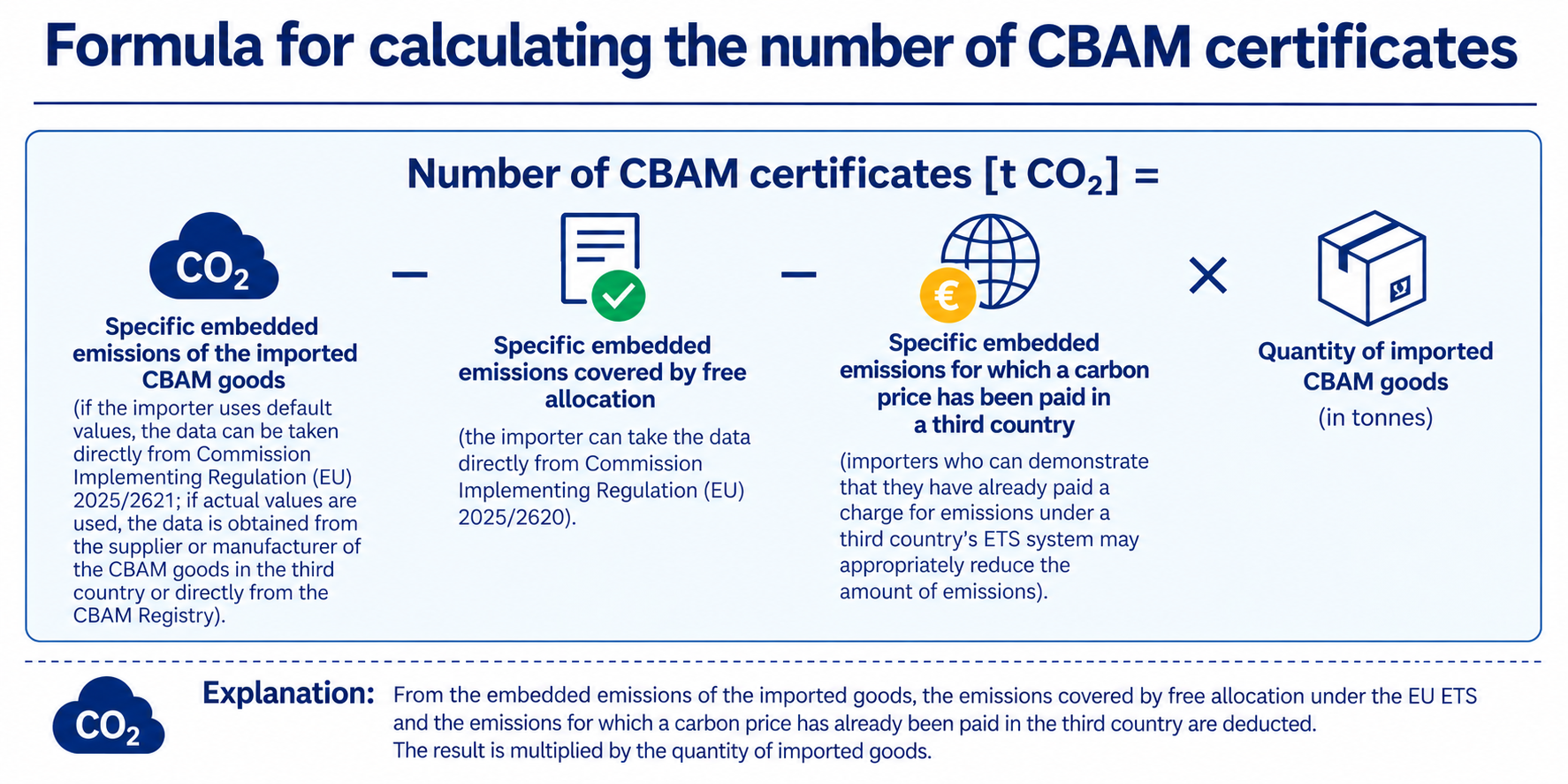
The specific embedded emissions covered by free allocation and the specific embedded emissions for which a carbon price was paid in a third country reduce the total emissions.
For several years, the specific embedded emissions covered by free allocation will reduce the total emissions of CBAM goods and, consequently, the number of certificates required. The reduction in total emissions due to free allocation under the CBAM mechanism was introduced to ensure a level playing field for producers in the EU and in third countries. EU producers receive free allowances under the ETS system; the legislator therefore introduced a comparable adjustment under the CBAM mechanism. In 2034, free allocation will be phased out both under the ETS system and the CBAM mechanism. This means that importers will gradually need more CBAM certificates.
The specific embedded emissions for which a carbon price was paid in a third country reduce the total emissions if the importer can demonstrate that the carbon price was actually paid in that third country.
Price of a CBAM certificate
In 2026, the price of CBAM certificates is determined as a quarterly average. It is based on the closing prices of allowances in the ETS system. At the time of preparing this article, the prices of CBAM certificates for the first three quarters of 2026 are known. They are as follows:
- 75,36 EUR for the period 1.1-31.3.2026
- 75,28 for the period 1.4.-30.6.2026
- 82,32 for the period 1.7.-30.9.2026
In 2027, the prices of CBAM certificates will be determined as the weekly average of the closing prices of allowances in the ETS system. The European Commission will publish the prices publicly and in the CBAM Registry.
Article prepared by: Mojca Müller, Certified tax adviser at the Slovenian Institute of Auditors
Let our team manage your CBAM compliance
Don’t wait until the next deadline or for missing supplier data. Work with us to establish a clear process and ensure your CBAM obligations are met on time.